PVD as an Alternative to Gold and Silver Plating
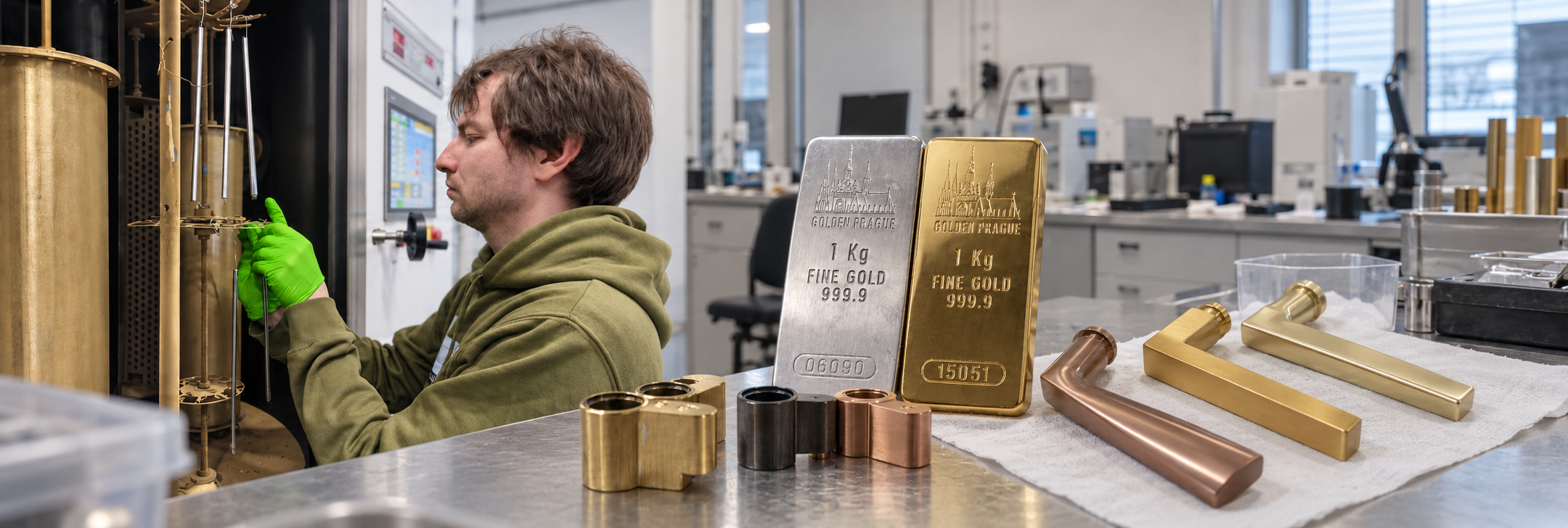
Gold. Beautiful, premium – and increasingly expensive. What if you could achieve a gold appearance without using gold? This is where decorative PVD coatings offer an alternative to traditional gold or silver plating. They can create an attractive, durable surface in shades of gold, silver, rose gold, and many other colors. We develop and test the coating directly on your parts and recommend the most suitable solution based on the material, desired shade, geometry, and conditions of use.
Where are decorative PVD coatings used?
Decorative PVD coatings are used wherever appearance, color stability, and surface durability are important. Typical applications include:
- jewelry and fashion accessories
- watches and watch components
- door handles, fittings, and interior accessories
- bathroom and kitchen faucets
- metal design elements and interior components
Why look for an alternative to gold and silver plating?
- reduce dependence on precious metal prices
- create an attractive metallic appearance
- achieve a more durable surface than some conventional decorative finishes
- develop a specific shade for a particular product
- ensure consistent surface appearance in serial production
- create colors that cannot be achieved with traditional gold or silver plating
However, PVD is not an automatic replacement for every electroplating process. We always evaluate the suitability of the solution based on the part material, geometry, application, and required appearance.
Two Ways to Create Your Own Decorative Finish
We first develop and test the decorative PVD coating on your actual parts. You can then choose one of two options depending on your production volume, investment possibilities, and long-term strategy.
Contract Coating in Jeneč near Prague
If you do not want to invest in your own PVD technology or only need to coat smaller quantities, we can handle the production for you.
At our facility in Jeneč near Prague, we offer:
- development of gold, silver, and other decorative PVD coatings
- trial coating of your parts
- one-off production and small production batches
- optimization of color, gloss, and surface texture
- quality control and repeatability checks
This option is especially suitable for new product development, market testing, custom production, or smaller series.
In-house PVD Coating at Your Production Site
For larger or regular production volumes, it may be more efficient to introduce decorative PVD coating directly into your own production.
We can help you:
- assess the return on investment of your own PVD technology
- test coatings before you invest
- define the required capacity and technical parameters
- select a suitable PVD coating system
- compare solutions from European and Asian manufacturers
- integrate the equipment into your production
- transfer the developed coating recipes to the new system
- start up and optimize the process
- train operators and technologists
- provide ongoing technical and laboratory support
We are not tied to a single equipment brand. We recommend the solution that best fits your product, required quality, production capacity, and budget.
From the First Sample to Your Own PVD Production Line
ou do not have to make the final decision at the beginning. We can start by developing the coating and producing smaller batches at our facility. Once your production volume grows and in-house technology starts to make economic sense, we can help you move the coating process into your own production.
We transfer the developed process to a suitable PVD system, support the start-up, and help you stabilize the production process.
Whether you choose contract coating with us or your own PVD technology, the goal is the same: a repeatable decorative finish that fits your product, production volume, and economic requirements.

Coating Development
We develop the composition, shade, and properties of the decorative PVD coating according to your product and requirements.

Test Parts
We test the coating directly on your parts and evaluate its appearance, adhesion, durability, and color match.

Contract Coating
Once the sample is approved, we can provide one-off coating jobs and small production batches at our facility in Prague.

Your Own PVD System
As your production volume grows, we help you select, purchase, and integrate a suitable PVD coating system into your production.
Frequently Asked Questions
Does a gold-colored PVD coating contain real gold?
No. Our standard gold-colored PVD coating does not contain real gold. The gold appearance is created using durable titanium- or zirconium-based compounds — specifically TiN (titanium nitride) and ZrN (zirconium nitride). TiN usually creates a richer yellow-gold shade, while ZrN can produce lighter gold to champagne tones.
The final appearance can also be influenced by the process settings, the interlayer used, and especially the surface preparation. The same coating can look different on a polished, brushed, or matte surface. The final shade is also affected by the substrate material, part geometry, polishing quality, surface cleanliness, and even the lighting conditions under which the product is evaluated.
For this reason, we always develop and test the gold-colored PVD coating directly on the actual part, ideally using a physical reference sample.
PVD technology can also be used to deposit real gold or to create multilayer coating systems with a very thin gold layer. At AdvaMat, we are also developing a transparent protective coating applied over a thin gold layer to help protect it against wear, scratching, and gradual abrasion. The goal is to preserve the appearance of real gold while extending the lifetime of the decorative surface.
Can PVD exactly reproduce the color of real gold?
Real gold does not have one universal shade. Its color depends on purity and alloy composition. While 24-carat gold has a characteristic rich yellow color, the addition of silver, copper, palladium, or other metals can create lighter, pink, reddish, or whitish tones. Even two alloys with the same carat value can therefore look different.
PVD can create a wide range of gold shades and can be matched very closely to a specific reference. However, the final color is influenced not only by the coating composition, but also by the substrate material, polishing, surface texture, part geometry, and lighting conditions. For this reason, we recommend providing a physical reference sample and preparing and approving a test part before production begins.
Is a PVD surface scratch resistant?
Yes. Gold-colored PVD coatings based on TiN or ZrN are significantly harder than real gold, which is naturally a soft metal. They can therefore provide substantially better resistance to scratching, abrasion, and everyday wear than a conventional thin gold layer.
However, a PVD surface is not indestructible. It is a very thin coating, and its final lifetime also depends on the substrate material, polishing and surface preparation, coating adhesion, coating structure, and the way the product is used. The most highly stressed areas are usually edges and surfaces that are in frequent contact with skin or other objects. For this reason, we recommend testing the coating directly on the actual part before serial production.
Can PVD coatings withstand sweat, cosmetics, and cleaning products?
Yes. Decorative PVD coatings are commonly used on jewelry, watches, eyewear, door handles, and other products that regularly come into contact with skin and sweat. A properly designed PVD coating can provide very good resistance to sweat, moisture, and everyday use.
Resistance to perfumes, creams, disinfectants, or cleaning products, however, depends on the specific coating composition, substrate material, and the intensity of exposure. Aggressive chemicals can gradually damage even a highly resistant surface. For this reason, we recommend testing the coating under the actual conditions in which the final product will be used.
Do you offer colors other than gold and silver?
Yes. In addition to gold and silver finishes, we also create rose gold, copper, bronze, chrome-like, grey, anthracite, and black shades.
Do you also coat individual parts and small batches?
Yes. Thanks to our own PVD coating equipment, we can produce test parts, one-off orders, and small production batches. For larger volumes, we first define and approve a reference sample.
Is PVD a full replacement for gold or silver plating?
In many decorative applications, yes — but not in all cases. Suitability depends on the substrate material, required shade, surface loading, part design, and expected lifetime. For this reason, we always verify the solution first through trial coating.
PVD expertise when you need it
Do you need to stabilize your coating process, solve a technical issue, or introduce a new PVD coating? Tell us about your equipment and the challenge you are facing. We will recommend the right level of support.
Ing. Martin Daněk, Ph.D.
[email protected]